
Last updated: October 2026
Models, pricing, reference numbers, waitlists, authentication, and value. One guide.
The hardest part of buying a Rolex isn't the money. It's the noise. Every forum has a consensus opinion. Every YouTube channel has a watch you must buy. Every dealer has an angle. Underneath all of it sits a simple question: which watch is right for you, and how do you get it without making an expensive mistake?
This guide covers the full current catalogue, real pricing, how the reference system works, what the nicknames mean, how to spot a fake, and whether buying pre-owned makes more sense than waiting at an authorized dealer. Work through it and you'll know more than most people standing in a showroom.
A few numbers before you start:
- Retail prices in 2026: $6,000 to $75,000+, with most steel sports models between $10,000 and $16,000
- Easiest first Rolex: Datejust, Oyster Perpetual, or Explorer
- Standard service cost: $800 to $1,600, needed roughly every ten years
- Secondary market premium on steel sports models: 15 to 40 percent above retail
- Faster path to ownership for most buyers: a reputable pre-owned dealer, not an authorized dealer list
In this guide:
- What makes Rolex different from other luxury watch brands?
- Which Rolex should you buy first?
- What are the main Rolex collections?
- How much does a Rolex cost in 2026?
- Should you buy from an authorised dealer or pre-owned?
- How do you read a Rolex reference number?
- What do Rolex nicknames like Pepsi and Batman mean?
- How do you know a Rolex is genuine?
- Do Rolex watches hold their value?
- How do you look after a Rolex?
- Where should you buy a Rolex?
What makes Rolex different from other luxury watch brands?
Rolex manufactures almost every component of its watches in-house, tests every movement to a standard stricter than official Swiss chronometer certification, and produces at a scale no other luxury watchmaker approaches. That combination is what separates it.
The specifics matter. Rolex uses Oystersteel, its own designation for 904L stainless steel, an alloy harder and more corrosion-resistant than the 316L used across most of the industry. It's significantly more difficult to machine, which is why almost nobody else bothers. Every Rolex movement carries Superlative Chronometer certification, guaranteeing accuracy within +2 to -2 seconds per day, roughly twice as strict as COSC. The current generation calibers deliver 70-hour power reserves, so a watch taken off on Friday evening is still running Monday morning.
Then there's the Oyster case, which turns 100 this year. Hans Wilsdorf patented the waterproof screw-down case in 1926, and it remains the foundation of nearly every watch the brand makes. It's the most important invention in the history of the wristwatch, and Rolex has spent a century refining rather than replacing it.
The result is a watch you can wear every day for decades with minimal fuss. That's the proposition, underneath the status conversation.
Which Rolex should you buy first?
For most first-time buyers, the Datejust, Oyster Perpetual, or Explorer make the most sense. They're the most versatile, the most accessible at retail, and the easiest to live with day to day.

The Oyster Perpetual is the purest expression of what Rolex does. Time-only dial, smooth bezel, Oyster bracelet, caliber 3230. Available in 28mm, 31mm, 34mm, 36mm and 41mm. It's the most affordable watch in the catalogue and there's nowhere for it to hide, which is why it's so impressive.
The Datejust does everything, and has been doing everything since 1945. Available in 31mm, 36mm and 41mm with an overwhelming number of configurations: smooth, fluted or gem-set bezel, Oyster or Jubilee bracelet, dozens of dial options. If you only ever own one Rolex, there's a strong case that this is the correct answer.
The Explorer is the underrated pick. 36mm or 40mm, 3-6-9 dial, smooth bezel, no date. A genuine tool watch that wears like a dress watch, with more modest secondary market premiums than the Submariner or GMT.
If your budget stretches further and you want a sports watch, the Submariner No-Date (ref. 124060) is as close to a perfect single watch as Rolex makes. Clean symmetrical dial, 300m water resistance, 41mm case, equally at home with a suit or a wetsuit.
Try them all on before deciding. The watch that photographs best is frequently not the watch that feels best on your wrist, and your wrist is the only reviewer that matters.
Further reading: the best first Rolex.
What are the main Rolex collections?
Rolex divides its catalogue into Classic and Professional lines, with Perpetual models sitting underneath both.
The Professional collection covers the purpose-built tool watches:
- Submariner. The dive watch. 41mm, 300m water resistance, unidirectional rotating bezel. Available as No-Date (124060) or Date (126610LN black bezel, 126610LV green bezel), plus two-tone and precious metal variants.
- GMT-Master II. The travel watch. 40mm, dual time zone, 24-hour rotating bezel. Four current bezel colorways: Pepsi, Batgirl, Sprite and Root Beer.
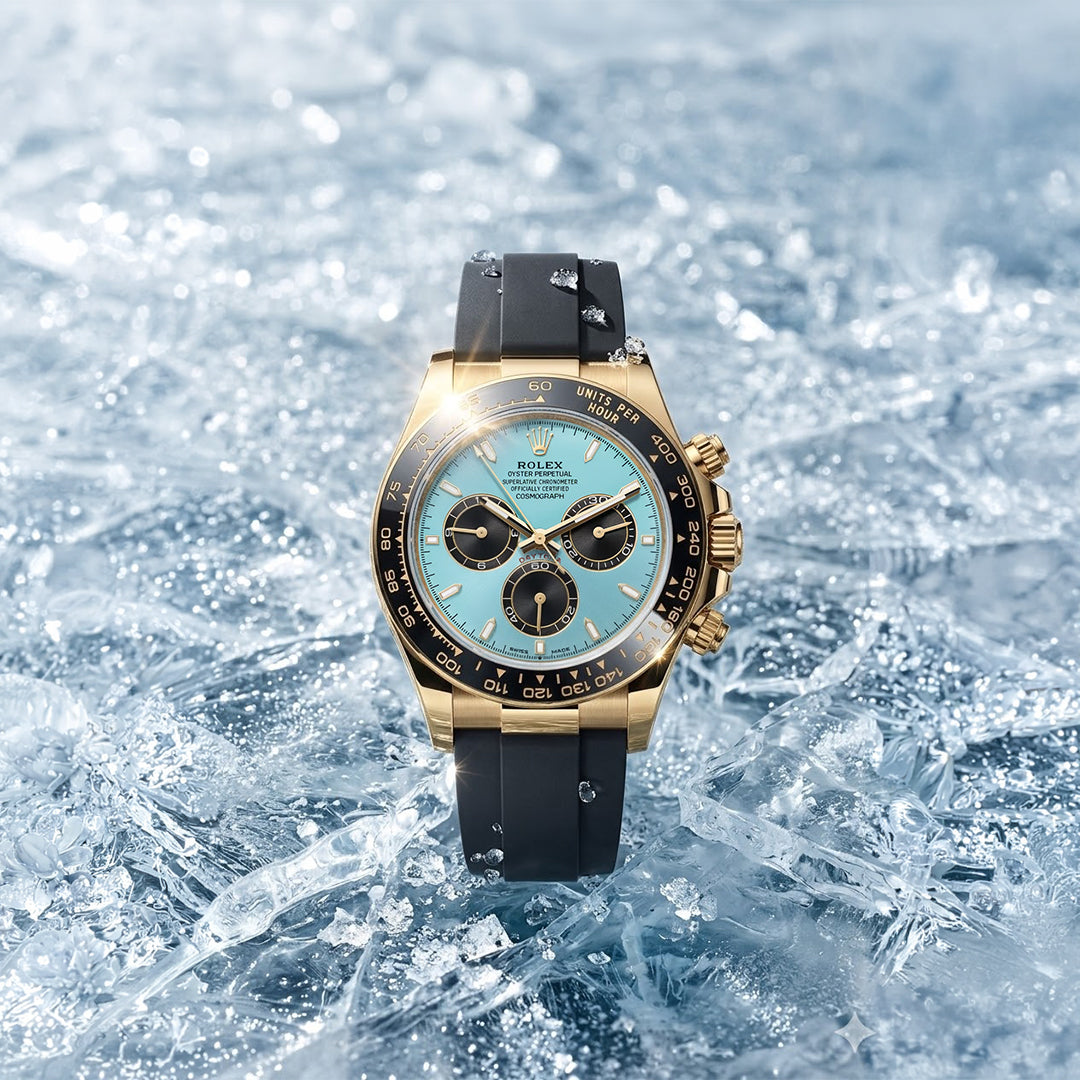
- Cosmograph Daytona. The chronograph. 40mm, tachymeter bezel, caliber 4131. The most sought-after Rolex in production, and as of 2026 available with a grand feu enamel dial in a Rolesium case.
- Explorer and Explorer II. The adventure watches. The Explorer is time-only in 36mm or 40mm. The Explorer II is a 42mm GMT with a fixed bezel and 24-hour hand.
- Sea-Dweller and Deepsea. The serious dive watches. 43mm and 44mm, water resistant to 1,220m and 3,900m respectively.
- Yacht-Master and Yacht-Master II. The sailing watches. The Yacht-Master is a luxury sports watch with a bidirectional bezel. The Yacht-Master II, relaunched in 2026 with the new caliber 4162, carries a programmable regatta countdown and is the most complicated watch Rolex makes.
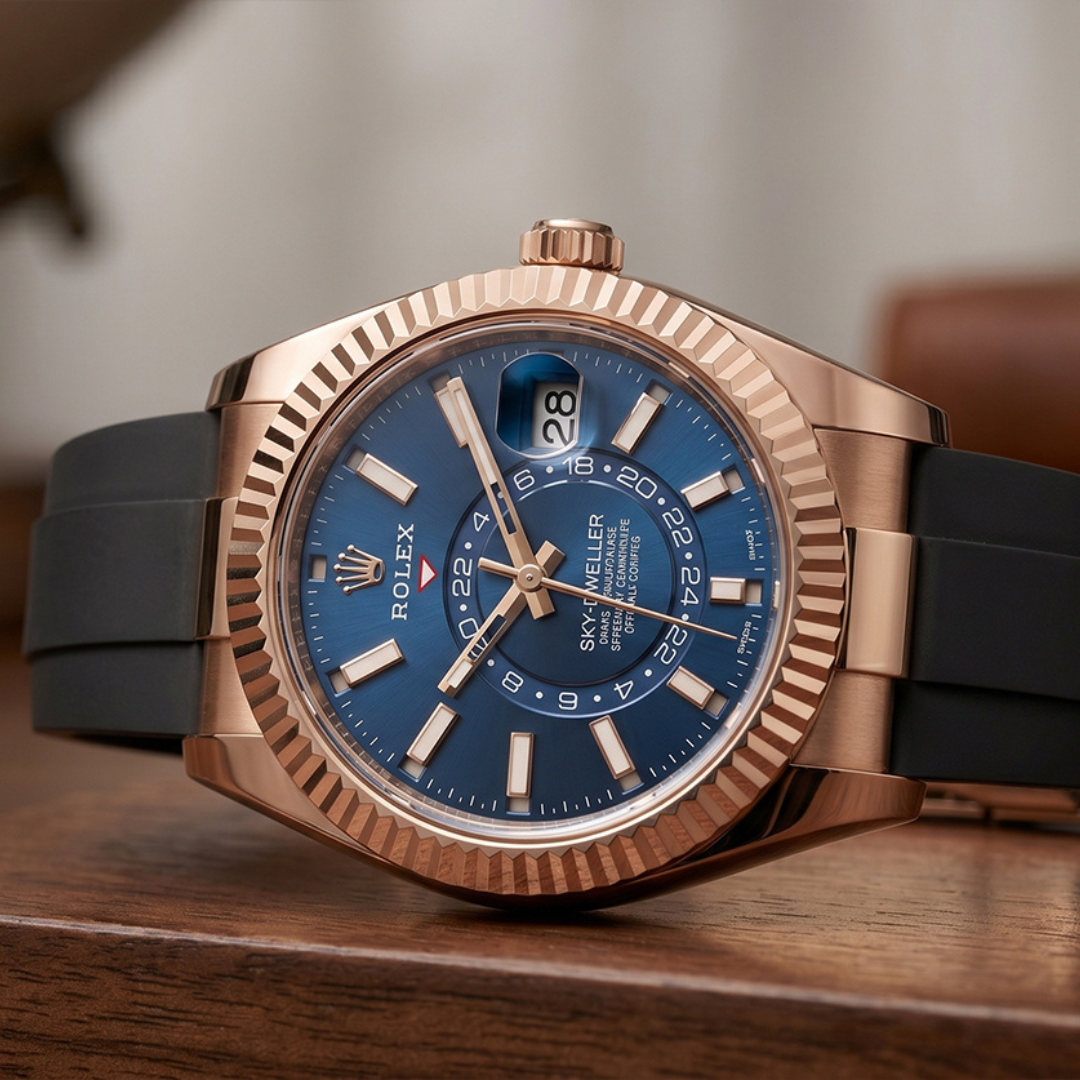
- Sky-Dweller. The annual calendar. 42mm, dual time zone, and a calendar needing correction once a year. Operated through the Ring Command bezel.
- Air-King. The aviation watch. 40mm, distinctive 3-6-9 dial with an outer minutes track, and a magnetic shield inherited from the Milgauss.
The Classic collection covers the dress and everyday watches:
- Oyster Perpetual. Time-only, five sizes, wide range of dial colors.
- Datejust. Date at 3 o'clock, three sizes, enormous configuration range.
- Day-Date. The President. Day and date on the dial, precious metals only, 36mm or 40mm.
- 1908. The dress watch. 39mm, precious metals only, and the only Rolex with a sapphire display caseback.
Further reading: individual guides to the Daytona, the GMT-Master II, the Sky-Dweller, the Day-Date and the 1908.
How much does a Rolex cost in 2026?
Rolex retail prices in 2026 start around $6,000 for the smallest Oyster Perpetual and climb past $75,000 for precious metal sports models, with most steel sports watches sitting between $10,000 and $16,000. Secondary market prices for popular steel models typically run 15 to 40 per cent above retail.
Current retail figures for the most requested models:
- Oyster Perpetual 36: around $7,000
- Datejust 36 (steel, Jubilee): around $8,000 to $9,500 depending on bezel
- Explorer 36: around $8,000
- Submariner No-Date (124060): around $10,050
- Submariner Date (126610LN): around $10,250 to $11,350
- GMT-Master II (126710BLRO Pepsi): around $11,500
- Sky-Dweller (steel): around $16,000
- Cosmograph Daytona (126500LN): around $15,500
- Day-Date 40 (yellow gold): around $45,000 and up
These are the prices Rolex publishes. They aren't, for most buyers, the prices you'll actually pay, because authorized dealer allocation falls well short of demand on the most popular references.
One nuance worth understanding: the retail-to-secondary gap varies enormously by model. Steel sports watches trade above retail. Precious metal models frequently trade at or below retail, which makes them one of the best-value entry points into the brand if you're buying pre-owned. A two-tone Submariner "Bluesy" or a gold GMT-Master II Root Beer often represents better value on the secondary market than the equivalent steel model.
Further reading: Submariner pricing, retail versus pre-owned.
Should you buy from an authorized dealer or pre-owned?
For most buyers in 2026, buying pre-owned from a reputable dealer is the more sensible path, because the total cost of securing a watch through an authorized dealer often exceeds the secondary market premium.
Authorized dealers allocate desirable models based on relationship and purchase history, not on when you joined a list. The unspoken expectation is that you'll buy watches you didn't necessarily want in order to earn access to the one you did. Collectors routinely report spending $15,000 to $30,000 on relationship-building purchases before being offered a Daytona.
Realistic current wait times, assuming some existing purchase history:
- Datejust, Oyster Perpetual, Explorer, Air-King: one to three months, sometimes immediate
- Submariner: one to six months
- GMT-Master II: three to six months, longer for the Pepsi
- Sky-Dweller: six to twelve months
- Daytona: six months to several years, depending entirely on your relationship
During the 2021 to 2022 speculative peak, secondary market premiums on steel sports models reached 50 to 70 per cent over retail, which made waiting worthwhile. That gap has since compressed substantially. A Submariner Date now trades roughly 15 to 30 per cent above retail. For many buyers, that premium is less than what they'd spend proving their loyalty at a dealer, and they get the watch now rather than waiting on a phone call that may never come.
Buying pre-owned isn't a compromise. It's frequently the better-informed decision, provided you buy from someone who authenticates properly and reports condition transparently.
Further reading: the Rolex waitlist in 2026, and what box and papers actually means.
How do you read a Rolex reference number?
A Rolex reference number encodes the model, case material and bezel type. On modern six-digit references, the first three or four digits identify the model family, the fifth digit indicates the material, and the final digit and letter suffix describe the bezel.
Take 126610LN, the Submariner Date:
- 1266 identifies the Submariner Date family
- 1 and 0 encode the case and bezel construction
- LN stands for lunette noire, French for black bezel
Material codes on the relevant digit:
- 0 = Oystersteel
- 3 = Steel and yellow gold (Rolesor)
- 5 = Steel and Everose gold
- 6 = Platinum
- 8 = Yellow gold
- 9 = White gold
Common bezel suffixes:
- LN = black bezel
- LV = green bezel
- LB = blue bezel
- BLRO = blue and red (Pepsi)
- BLNR = blue and black (Batgirl or Batman)
- VTNR = green and black (Sprite)
- CHNR = brown and black (Root Beer)
Once you can read these, you can verify at a glance whether a listing description matches the watch being sold. If someone advertises a "steel Submariner" but the reference ends in 8, it's gold. If a GMT is listed as a Pepsi but carries a BLNR suffix, it's a Batgirl.
The serial number is separate, engraved on the rehaut at 6 o'clock on watches made after 2008 and between the lugs on older pieces. Rolex randomized serial numbers around 2010, so they can no longer be used to determine production year. Any lookup tool claiming otherwise is guessing.
Further reading: the complete guide to Rolex reference numbers, and how to find your serial number.
What do Rolex nicknames like Pepsi and Batman mean?
Rolex nicknames are community-invented shorthand for specific bezel and dial configurations. Rolex has never used them officially, but every dealer and collector understands them.

- Pepsi. GMT-Master II with blue and red bezel (126710BLRO)
- Batman. GMT-Master II, blue and black bezel, Oyster bracelet (116710BLNR, discontinued)
- Batgirl. Same colors, current generation, Jubilee bracelet (126710BLNR)
- Sprite. GMT-Master II, green and black bezel, left-hand crown (126720VTNR)
- Root Beer. GMT-Master II, brown and black bezel in Everose Rolesor (126711CHNR)
- Hulk. Submariner with green dial and green bezel (116610LV, discontinued)
- Kermit. Submariner with green aluminum bezel and black dial (16610LV)
- Starbucks. Current Submariner with green ceramic bezel and black dial (126610LV)
- Panda. Daytona with white dial and black subdials
- Wimbledon. Datejust or Day-Date with green Roman numerals on slate grey
- President. The Day-Date, and specifically its bracelet
Knowing these makes conversations with dealers faster and signals that you know what you're looking for.
Further reading: the full guide to Rolex nicknames.
How do you know a Rolex is genuine?
Authentication comes down to weight, engraving precision, movement quality and bracelet construction. Counterfeits have improved substantially, but they still fail under close inspection.
Weight. Genuine Rolex cases and bracelets are machined from solid metal. The density is immediately obvious in the hand. Most fakes feel noticeably light.
The Cyclops. On a real Rolex the date lens magnifies 2.5x and the numerals fill the window almost completely. Fakes routinely under-magnify.
The rehaut engraving. "ROLEX" repeated around the inner rim, laser-etched with perfect uniformity. Counterfeit engravings show uneven depth and spacing under magnification.
The crown etching. A tiny crown logo etched into the crystal at 6 o'clock, deliberately near-invisible. If you can see it easily from arm's length, be suspicious.
The caseback. Apart from the 1908, no current Rolex has a display caseback. A see-through Submariner or Daytona is fake, full stop.
The movement. The seconds hand sweeps at 28,800 beats per hour, eight beats per second, in a smooth motion. Any visible stutter is a problem.
The simplest protection is buying from a dealer who authenticates every watch and provides macro photography of the serial, reference and rehaut engravings without being asked. No price is good enough to justify the risk.
Further reading: the detailed guide to spotting a fake Rolex.
Do Rolex watches hold their value?
Yes. Rolex holds value better than virtually any other luxury good, and steel sports models frequently trade above their retail price.
The mechanics are structural rather than speculative. Rolex constrains production deliberately. Demand consistently exceeds supply on key references. The brand is recognized globally, which creates the deepest and most liquid secondary market in watchmaking. And the watches last decades with routine servicing, so there's no obsolescence risk.
Steel sports models are the strongest performers. Discontinued references perform best of all: the Hulk Submariner retailed around $9,000 before being discontinued in 2020 and now trades well above $16,000. Precious metal models hold value solidly without appreciating the same way, largely because they're bought by people who want to wear them rather than trade them.
Worth keeping in perspective: a watch shouldn't be your investment strategy. But as a store of value you actually get to use, Rolex sits in a category with very few competitors.
Further reading: are Rolex watches a good investment in 2026.
How do you look after a Rolex?
Service a Rolex roughly every ten years for modern calibers, keep it away from magnets and chemicals, and resist the urge to polish it every time it picks up a scratch.
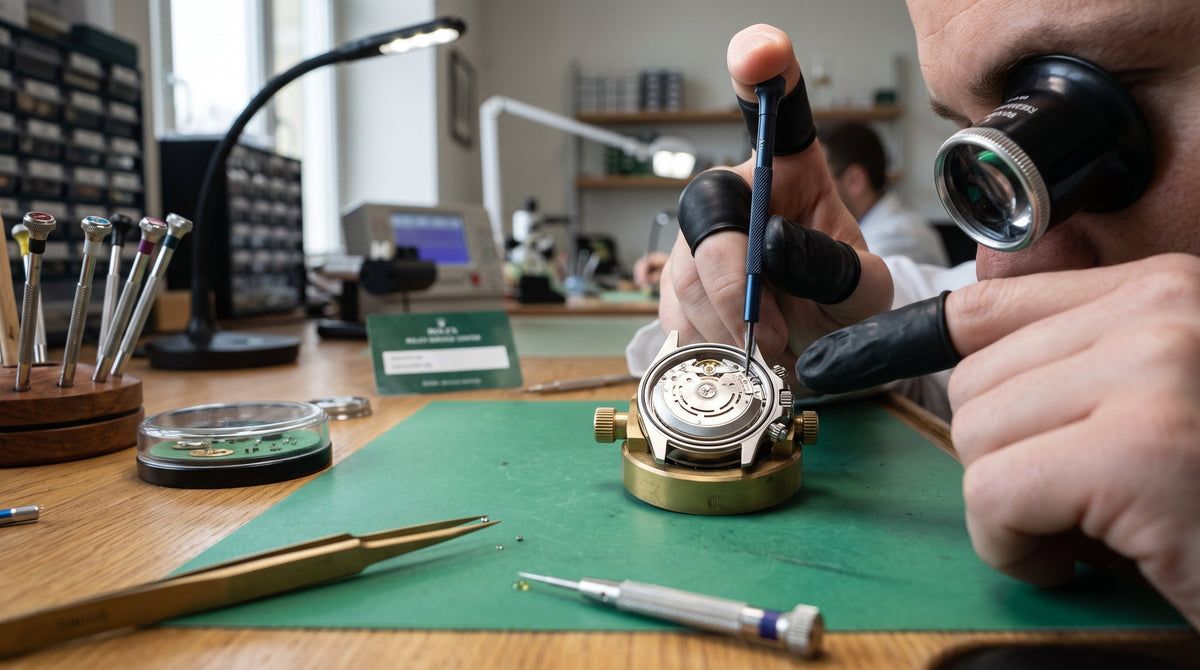
A full service involves complete disassembly, ultrasonic cleaning, replacement of worn components and gaskets, re-lubrication, reassembly, regulation, and pressure testing. Expect somewhere between $800 and $1,600 through an authorized service center depending on the model.
Water resistance degrades over time as gaskets dry out and compress, which is why pressure testing during a service matters. A watch that hasn't been serviced in a decade shouldn't be assumed to still meet its original rating, however well it's running.
On polishing: every polish removes a microscopic layer of metal, softening edges and rounding lugs over time. Light scratches are evidence of a watch being worn, not damage. Polish sparingly, and only through a qualified watchmaker.
Further reading: the full Rolex service cost guide, and the luxury watch maintenance guide.
Where should you buy a Rolex?
Buy from an authorized dealer if you have an established relationship and the patience to wait. Otherwise, buy from a specialist pre-owned dealer who authenticates every watch and reports condition transparently.

What to look for in a pre-owned dealer:
- Full authentication on every watch, with documentation
- Macro photography of serial, reference and rehaut engravings
- Clear condition reporting, including polish status
- Transparency about what's included: box, papers, service history
- A willingness to answer direct questions without deflecting
The secondary market is safe when you buy from the right source and risky when you don't. Reputation matters more than price. A saving of a few hundred dollars means nothing against the cost of a watch that turns out to be something other than what it was sold as.
Every watch at Dial Society is fully authenticated with transparent condition reporting and no waitlist. Browse the Rolex collection or request a specific reference and we'll source it for you.