
Gold, platinum, and a legacy that stretches from world leaders to hip-hop royalty. Here's everything you need to know about the Rolex Day-Date.
There's a moment I keep coming back to. I was at a watch event a couple of years ago, and a collector walked in wearing a Day-Date 40 in platinum with a baguette diamond dial.
No fanfare.
No wrist roll for the camera.
Just this quiet, heavy, impossibly beautiful watch catching the light every time he reached for his drink. I'd seen hundreds of Submariners and Daytonas by that point. But the Day-Date stopped me in my tracks.
It stuck with me because the Day-Date doesn't get the same breathless coverage as Rolex's sports models.
There are no waitlist horror stories, no nickname culture, no Reddit threads debating which bezel insert is superior. And yet, it might be the most significant watch Rolex has ever made.
A Very Brief History

Launched in 1956, the Day-Date was the first wristwatch to display both the day of the
week and the date on the dial. That sounds unremarkable now, but at the time it was a genuine technical achievement.
More importantly, Rolex made a deliberate decision that still defines the watch today: the Day-Date would only ever be produced in precious metals. Gold or platinum. No steel. No two-tone. Ever.
That exclusivity positioned the Day-Date as a symbol of achievement from the very beginning. It earned the nickname "the President" after Rolex reportedly gifted one to Dwight D. Eisenhower (though the specific history there gets a bit murky depending on who you ask).
What's not murky is the legacy that followed. Lyndon Johnson wore one. So did various heads of state, business leaders, and eventually a long line of musicians and athletes who understood the watch's cultural weight.
The Day-Date became shorthand for having arrived, and that association has never really faded.
Why It Hits Different in 2026
Here's what I think a lot of collectors miss about the Day-Date: in an era where everyone is chasing steel sports watches, the Day-Date is almost contrarian.
It's a dress watch in a market obsessed with tool watches. It's precious metal in a world that fetishises stainless steel. And it doesn't apologize for any of it.
The current Day-Date 40 (ref. 228235 in Everose gold, ref. 228206 in platinum) runs on the calibre 3255, which delivers a 70-hour power reserve and Rolex's Superlative Chronometer certification.

The case is 40mm, which wears larger than you'd expect thanks to the President bracelet's visual heft. And the dial options are genuinely extraordinary. From classic sunburst champagne to meteorite to fully paved diamonds, the Day-Date offers a level of personalization that no other Rolex comes close to matching.
I'll be honest: the diamond and gem-set configurations aren't really my thing. But I've come around to understanding why they exist. The Day-Date is the one Rolex where maximalism is part of the DNA.
If you want restraint, there's a fluted bezel with a clean dial waiting for you. If you want to make a statement that's visible from across the room, there's a configuration for that too. Both are equally valid, and that range is part of what makes the Day-Date special.
Day-Date vs. Datejust: The Question Everyone Asks

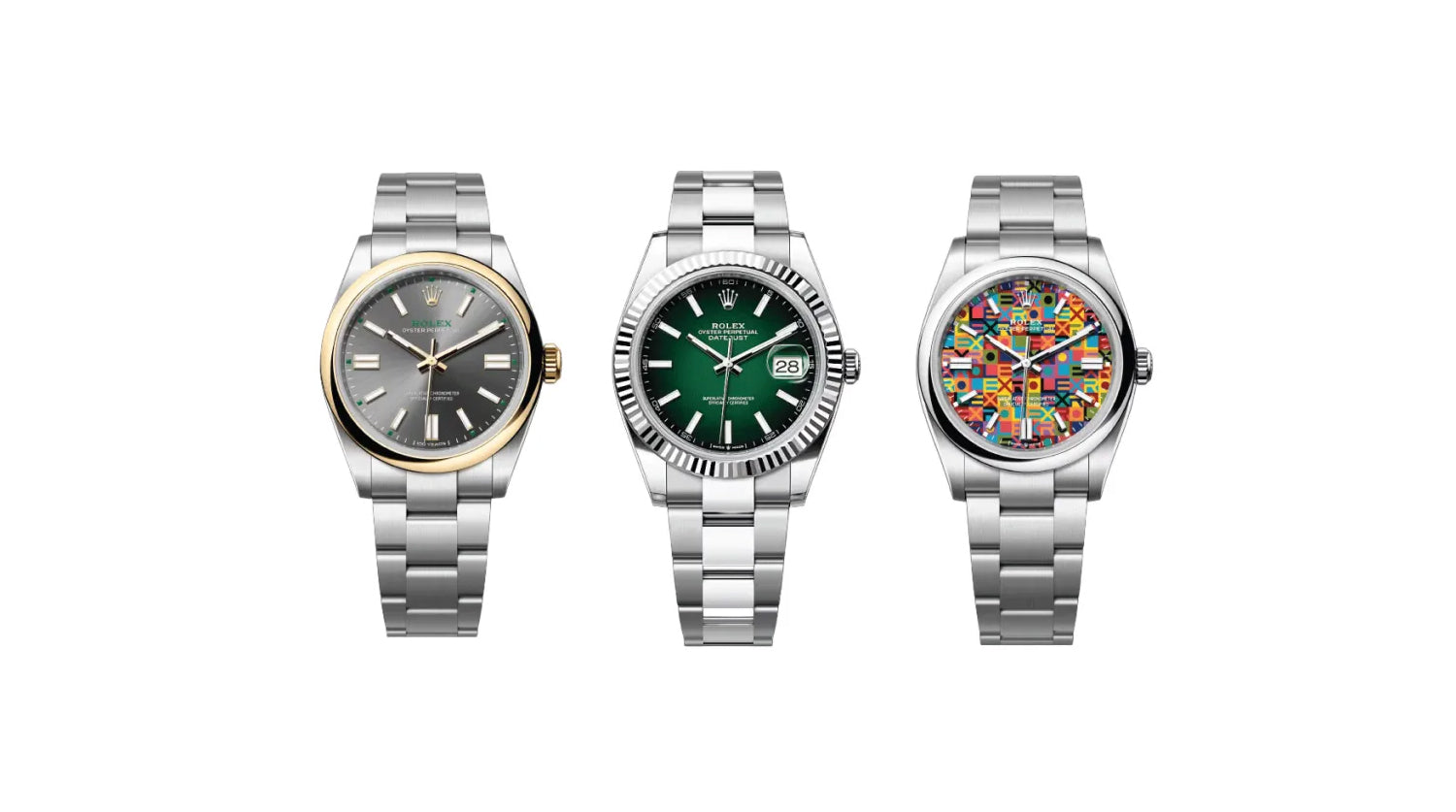
This comes up constantly, so let's address it properly. The Datejust is available in steel, Rolesor (two-tone), and precious metals. The Day-Date is precious metals only. The Datejust shows the date.
The Day-Date shows the day and the date. The Datejust is versatile and accessible. The Day-Date is unapologetically luxurious.
Think of it this way: the Datejust is the watch you wear because it works with everything. The Day-Date is the watch you wear because you've reached a point where you want something that doesn't compromise.
They're not really competitors. They're different chapters of the same story, and most serious Rolex collectors end up owning both eventually.
Where It Fits in a Collection
The Day-Date is rarely anyone's first Rolex. And that's perfectly fine. It's the watch you graduate to after the Submariner or the GMT-Master II has been your daily for a few years and you start wanting something that occupies completely different territory on the wrist.
I've spoken to collectors who describe buying their Day-Date as the moment their collection finally felt complete. There's a good reason for that. A steel sports watch and a precious metal dress watch cover virtually every situation you'll ever walk into.
The Day-Date fills a gap that no sports model, no matter how versatile, can touch.
And here's the thing that surprised me most about the Day-Date: it's more wearable than you'd expect. The President bracelet drapes over the wrist with a fluidity that belies the weight of solid gold.
It doesn't feel stiff or overly formal. It feels considered. Every link, every surface, every transition between brushed and polished has been thought through in a way that only becomes obvious once you've worn it for a few hours.

The Quiet One
I keep finding myself drawn back to the Day-Date. In a market full of noise, full of hype drops and waitlist drama and secondary market speculation, there's something deeply appealing about a watch that just sits there, in solid gold, completely unbothered.
It doesn't need a nickname. It doesn't need a subreddit. It's been the quiet choice of people who don't need to prove anything for nearly seventy years, and it'll still be here long after the current hype cycle has moved on.
You'll know when you're ready for it
Browse our Day-Date collection at Dial Society or request a specific reference.