The most sought-after chronograph in the world comes in more configurations than most people realize. Here’s how to navigate the full lineup.
I have a theory about the Rolex Daytona. I think most people who want one have a very specific image in their head: white dial, black subdials, steel bracelet. The “Panda.” And fair enough, it’s one of the most beautiful watches ever made. But the Daytona family in 2026 is far broader, far more varied, and far more interesting than that single reference. There are steel models, gold models, platinum models, two-tone configurations, and as of this year, a Rolesium enamel dial that nobody saw coming.
So whether you’re chasing your first Daytona or trying to figure out which variant makes sense for your collection, here’s the full picture.
Oystersteel: The Ones Everyone Wants
The steel Daytona is where the obsession starts, and for good reason. The ref. 126500LN replaced the legendary 116500LN in 2023, updating the case with redesigned lugs and a slightly different crown guard profile while retaining the 40mm diameter and the caliber 4131 movement with its 72-hour power reserve.
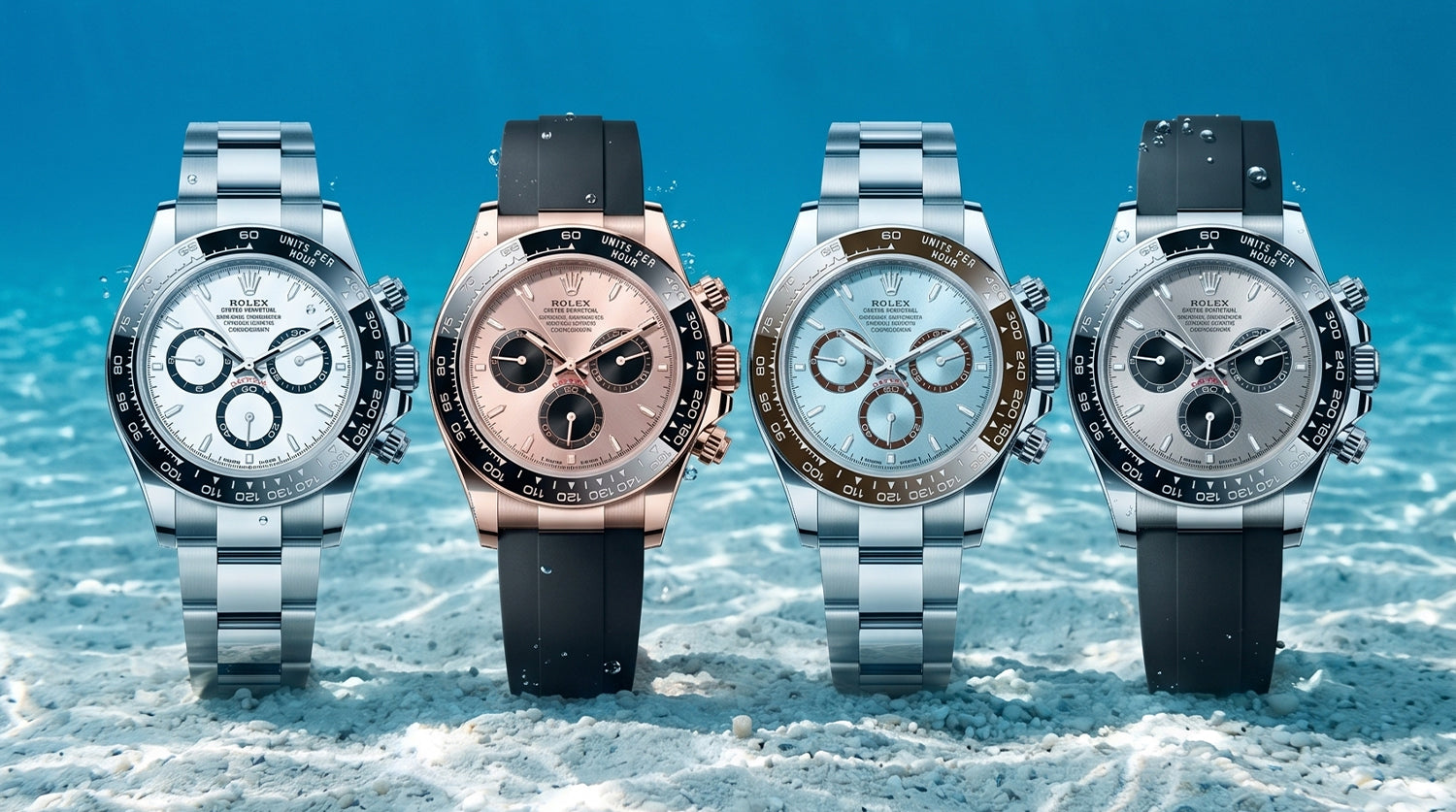
Two dial options: white dial with black subdials (the Panda) or black dial with silver subdials (the Reverse Panda). Both feature the black Cerachrom bezel with tachymeter scale. Both are virtually impossible to source at retail. Both trade at significant premiums on the secondary market.
If I’m being completely honest, the white dial is the one that does it for me. There’s a crispness to the contrast that just works, and it catches light in a way the black dial can’t quite match. But I’ve spoken to plenty of collectors who feel the opposite, and they’re not wrong. The black dial is more versatile in everyday wear and arguably more legible in bright conditions.
Best for: The collector who wants the definitive modern sports chronograph. The steel Daytona is the benchmark against which every other chronograph is measured, and secondary market performance reflects that.
Rolesium (NEW for 2026): The Enamel Daytona
This is the headline piece from Watches and Wonders 2026, and it deserves its own section. The ref. 126502 pairs an Oystersteel case with a platinum bezel and caseback in a “Rolesium” construction that’s a first for the Daytona line.
The dial is white grand feu enamel, fired on a ceramic base rather than directly on metal, across four separate pieces. The bezel is anthracite Cerachrom rather than the familiar black, with horizontally aligned tachymeter markings that nod to vintage references. And for the first time on a non-precious-metal Daytona, there’s a sapphire exhibition caseback showing the caliber 4131. The catch: this is an off-catalogue model. Low production, not part of the standard range. If you thought the steel Daytona was hard to find, this one will be another level entirely. But the fact that Rolex has introduced artisanal dial-making techniques to the Daytona line feels genuinely significant. This isn’t just a new reference.
It’s a new direction.
Best for: The collector who wants something historically significant. This is the kind of Daytona that people will be talking about in twenty years.
Yellow Gold: The Classic Precious Metal Daytona
The yellow gold Daytona has been part of the collection for decades, and the current references carry the same caliber 4131 as the steel models. The ref. 126508 on an Oyster bracelet is available with a green dial (which has become a genuine icon in its own right) or a champagne dial. There’s also the ref. 126518LN on an Oysterflex rubber strap, which pairs beautifully with a champagne or meteorite dial.
The green-dial 126508 is, for my money, one of the most striking Daytonas Rolex has ever produced. Green and gold sounds like it shouldn’t work, but in person, it’s extraordinary.
The sunburst dial shifts between deep emerald and near-black depending on the light.
Best for: The buyer who wants a precious metal chronograph with serious wrist presence. The yellow gold Daytona makes a statement that the steel version, for all its desirability, simply can’t.
Everose Gold: The Warm Alternative
Rolex’s proprietary pink gold alloy gives the Daytona a warmth that traditional rose gold can’t match, and crucially, it’s engineered to resist fading over time. The ref. 126505 on an Oyster bracelet or the ref. 126515LN on Oysterflex are both available with chocolate brown or Sundust pink dials.
The chocolate dial on Oysterflex is a combination I find myself recommending constantly. It’s dressier than steel but more relaxed than yellow gold, and the rubber strap makes it genuinely comfortable as a daily wearer. It sits in a sweet spot that not many watches occupy.
Best for: The buyer who wants precious metal without the visual intensity of yellow gold. Everose is the Daytona for people who prefer warmth over flash.
White Gold and Platinum: The Top of the Range
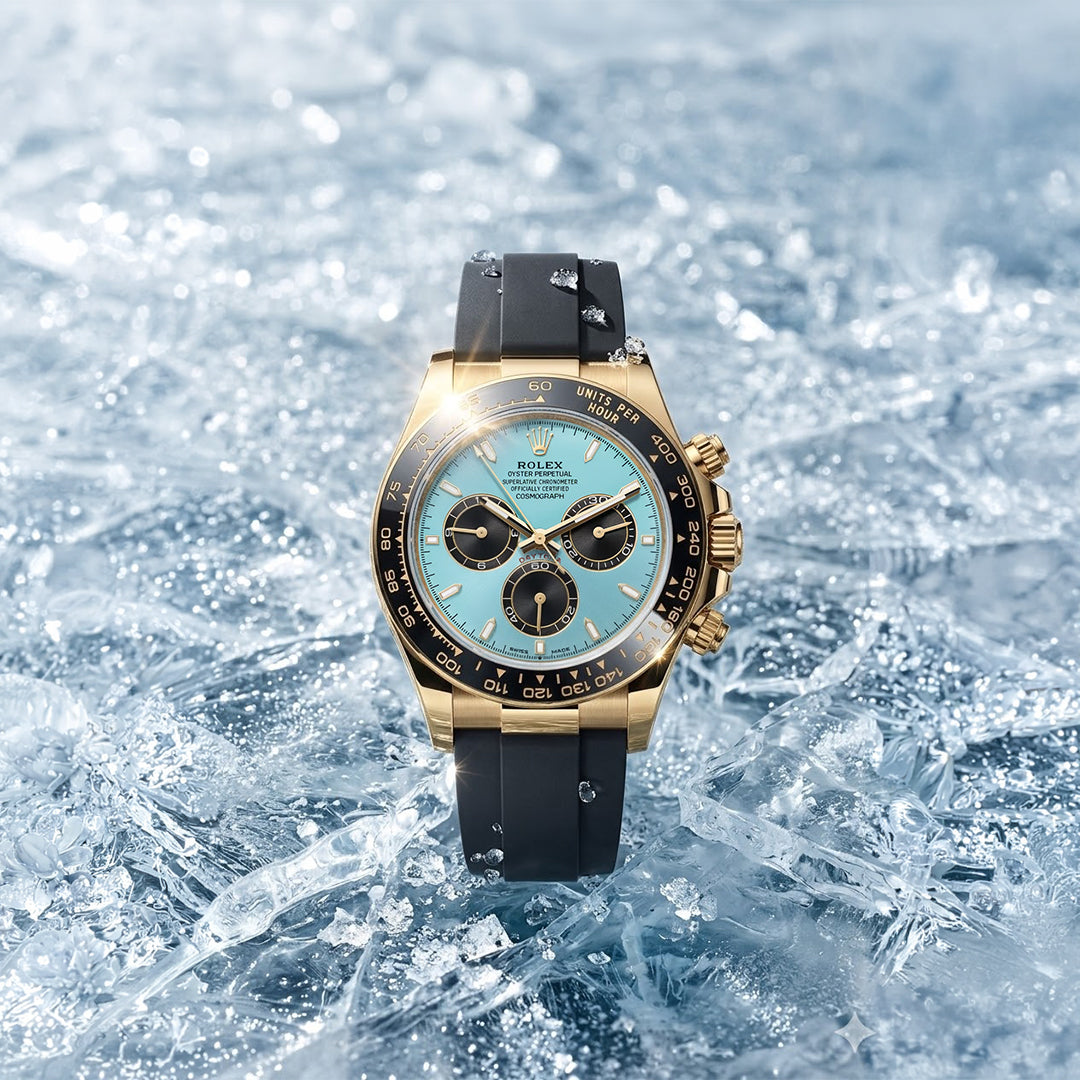
At the very top of the Daytona hierarchy sit the white gold and platinum references. The ref. 126509 in white gold on an Oysterflex strap offers a panda dial configuration that reads like steel from a distance but carries a completely different weight and finishing quality up close. The platinum ref. 126506 with its ice blue dial is the undisputed grail of the current Daytona lineup.
The ice blue color is exclusive to Rolex’s platinum models across the entire catalogue, and on the Daytona it’s paired with a chestnut brown Cerachrom bezel that creates a contrast unlike anything else in the range. It’s also the most expensive standard-catalogue Daytona by a significant margin.
Best for: The collector who already owns a Daytona in steel or gold and wants the pinnacle. The platinum ice blue is a destination watch, the kind of piece you work toward over years.
Under the Hood: What They All Share
Every current Daytona runs on the caliber 4131, Rolex’s latest chronograph movement. It delivers a 72-hour power reserve (up from 48 on the previous 4130), uses the Chronergy escapement for improved efficiency, and carries Superlative Chronometer certification to +2/-2 seconds per day. The case is universally 40mm, water resistant to 100 meters. The movement is identical across every material. Steel, gold, platinum: same caliber, same performance. Your choice is entirely about aesthetics, weight, and how much you want to spend.

So, Which Daytona?
If you want the icon that everyone recognizes, go steel. If you want the conversation piece of 2026, chase the Rolesium enamel. If you want warmth and wearability, Everose on Oysterflex is hard to beat. And if you want the grail, the platinum ice blue is waiting.
Every Daytona is a great Daytona. The question is which one is yours.
We carry Daytona references across steel, gold, and platinum. Browse the collection or request a specific reference.