

They're not for everyone. But there are real reasons behind those prices, and they're worth understanding.
I'll never forget the first time I held a Richard Mille. It was an RM 035, and the thing that struck me wasn't the look. It was the weight. Or rather, the complete absence of it. A watch that costs more than most houses, and it felt like it might float off my wrist. That dissonance between price and physical heft is, in many ways, the entire Richard Mille story. And it's the reason people either obsess over the brand or dismiss it entirely.
So let's talk about why these watches cost what they cost. Not to justify the price tag, necessarily, but to understand what's actually going on behind those tonneau-shaped cases.
The Materials Are Genuinely Extraordinary
This is where Richard Mille separates itself from virtually every other watchmaker on the planet. While most luxury brands work with variations on steel, gold, platinum, and ceramic, RM operates in a completely different material universe.
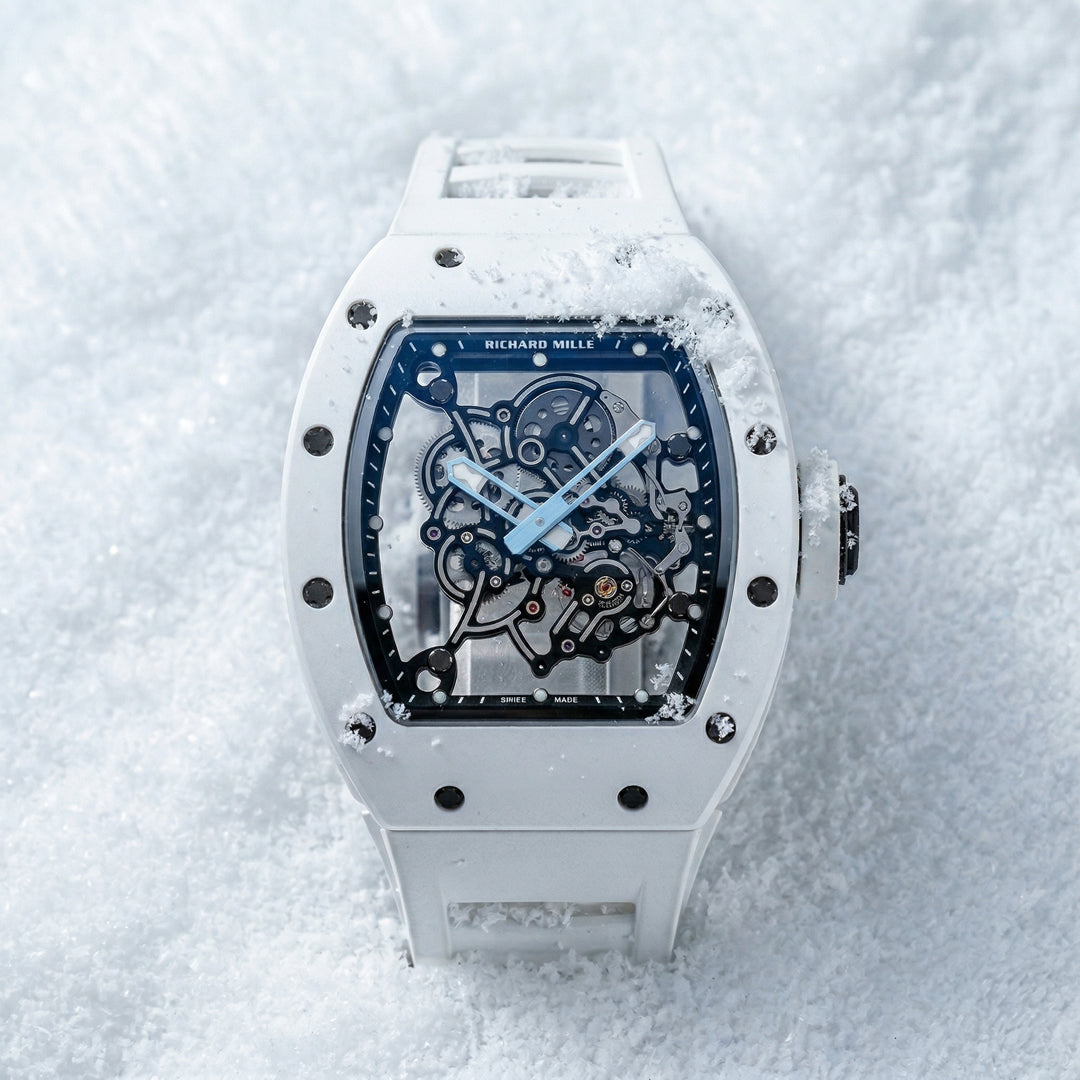
Carbon TPT is the signature. Layers of carbon fiber, each no thicker than 30 microns, stacked at alternating 45-degree angles and cured under immense heat and pressure. The result is a case material that's extraordinarily strong, shockingly light, and produces that distinctive marbled pattern that no two watches share. Quartz TPT uses a similar process with silica fibers, producing vivid colors (the deep reds and blues you see on certain limited editions) while maintaining the same structural properties.

Then there's grade 5 titanium, NTPT gold (a Richard Mille exclusive that bonds gold with carbon composite for scratch resistance), and ceramic composites engineered to survive forces that would destroy a conventional watch case. These aren't marketing gimmicks. They're materials borrowed from Formula 1, aerospace, and advanced engineering, adapted for something you wear on your wrist. The R&D costs behind each new material are staggering, and they feed directly into the retail price.
The Movements Are Built Like Race Cars
Richard Mille calibers are designed around a philosophy the brand calls "a racing machine on the wrist," and having handled a few, I can tell you that's not just copywriting. The movements are skeletonized extensively, not for decoration, but to reduce mass. Baseplates and bridges are machined from titanium or carbon composite rather than traditional brass. The tolerances are extreme, the finishing is meticulous, and every component is engineered to withstand forces that most watch movements would never encounter.
The RM 27-04, designed for Rafael Nadal, survives accelerations of over 12,000 Gs. That's not a typo. It's a tourbillon movement that weighs less than a fifty-cent coin and can handle forces
equivalent to a professional tennis serve. Whether you think that level of engineering is necessary in a wristwatch is a fair debate. But the fact that it exists, and that Richard Mille is one of the only houses on earth capable of producing it, tells you something about where the money goes.
Production Numbers Are Tiny
Richard Mille makes fewer than 5,000 watches per year. Across the entire brand. For context, Rolex produces roughly a million. Patek Philippe makes around 70,000. Even Audemars Piguet, which prides itself on exclusivity, produces roughly 50,000.
That level of scarcity is deliberate, and it creates a secondary market dynamic that's unlike anything else in watchmaking. Demand vastly outstrips supply for desirable references, and prices at auction regularly exceed retail (which is already astronomical). When you buy a Richard Mille, you're buying into one of the most tightly controlled supply chains in luxury goods. Whether that feels like genuine exclusivity or artificial scarcity probably depends on your perspective, but the market effect is undeniable. Sought-after references appreciate rapidly, and there's virtually no risk of oversupply diluting values.
The Celebrity Factor (Love It or Hate It)
You can't talk about Richard Mille pricing without addressing the elephant in the room. The brand has cultivated relationships with athletes and celebrities (Nadal, Pharrell Williams, Bubba Watson, Felipe Massa) in a way that no other haute horlogerie house has attempted at this scale. And these aren't just endorsement deals. The watches are often engineered around the specific demands of each ambassador's sport or lifestyle.

Does that add to the price? Indirectly, yes. The visibility keeps demand white-hot, and the association with peak performance reinforces the brand's positioning at the very top of the market. It's a strategy that purists love to criticize, but it's worked spectacularly well. Richard Mille is one of the few independent watchmakers that has achieved genuine name recognition outside the watch community, and that recognition supports the entire price architecture.
So, Are They Worth It?
That depends entirely on what "worth it" means to you. If you evaluate a watch purely on movement finishing per dollar, there are stronger propositions at lower price points. If you judge by materials innovation, engineering extremes, and genuine scarcity, Richard Mille is in a class of one.
I'll put it this way: I've handled watches from every major maison. Very few have made me fundamentally reconsider what a wristwatch can physically be. Richard Mille did that the first time I picked one up, and it's done it every time since. You don't have to agree with the price. But once you understand what's behind it, dismissing the brand gets a lot harder.
Explore our Richard Mille collection at Dial Society or request a specific reference.