
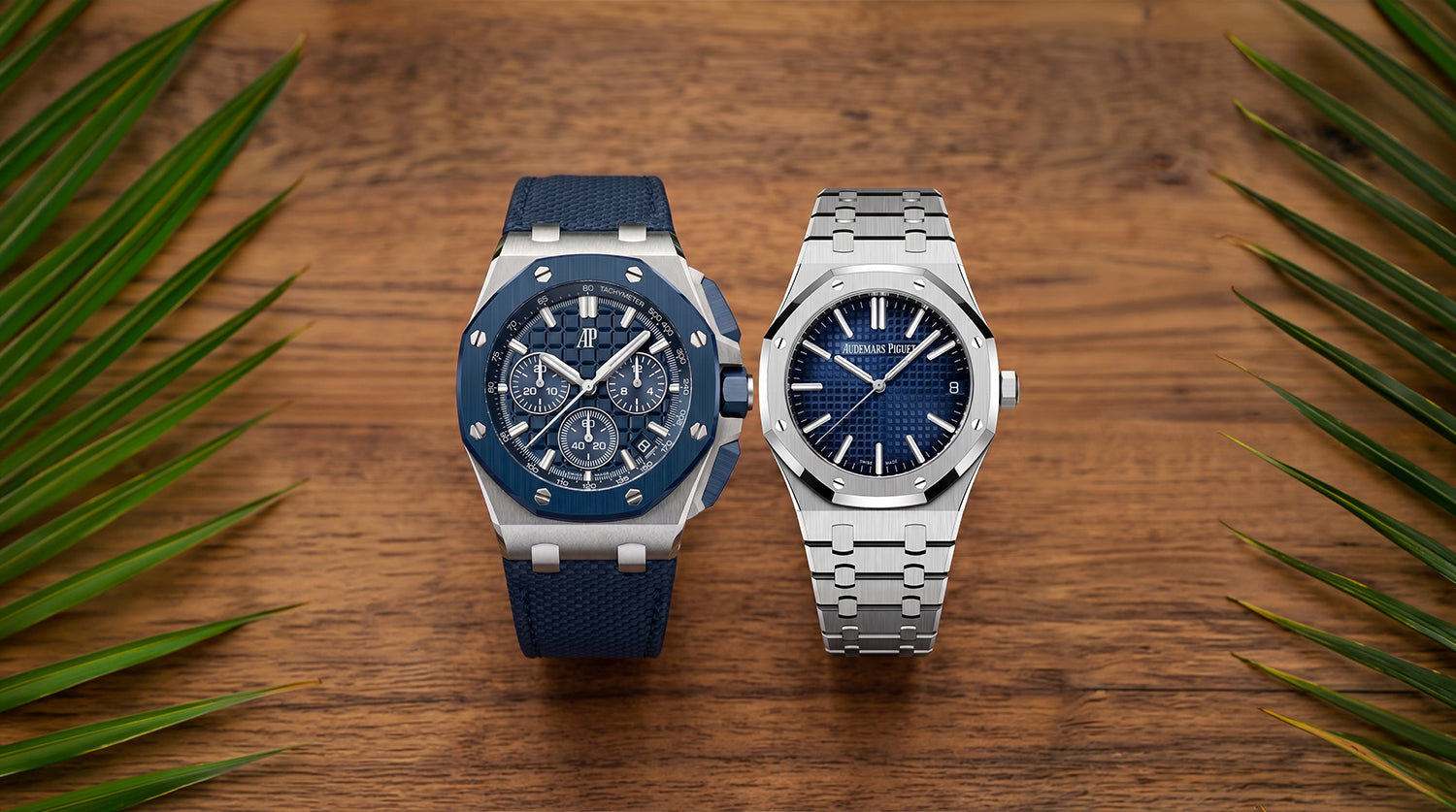
Same DNA, very different watches. Here’s how to decide which Royal Oak is actually right for you.
I remember the first time I saw a Royal Oak Offshore in person. I’d been wearing a regular Royal Oak for a few hours at a dealer event, feeling very pleased with myself, and then someone across the room pulled up their sleeve to reveal a 44mm Offshore Diver in full titanium. It was like seeing a sibling you didn’t know existed. The family resemblance was unmistakable, but everything about it was bigger, louder, and more deliberately aggressive. I spent the rest of the evening trying to figure out which one I’d actually choose if I could only have one.
That question haunts more Audemars Piguet buyers than you’d think. The Royal Oak and the Royal Oak Offshore share a name, a designer lineage, and that iconic octagonal bezel with exposed hexagonal screws. But they’re built for fundamentally different people, and understanding the distinction before you spend five or six figures is worth the time.
The Royal Oak: Gerald Genta’s Masterpiece
The original. Launched in 1972, designed by Gerald Genta overnight (legend has it he sketched it on a napkin at his kitchen table the night before the Basel watch fair). The Royal Oak was scandalous at the time: a luxury sports watch in stainless steel, priced above gold dress watches, with an industrial aesthetic that the Swiss establishment found borderline offensive.
Five decades later, it’s arguably the most architecturally significant watch ever made. The current flagship is the ref. 15510ST: 41mm in stainless steel, powered by the caliber 4302 with a 70-hour power reserve. The case is 10.4mm thick. The integrated bracelet flows from the case with a seamlessness that no other brand has successfully replicated, despite decades of trying. What makes the Royal Oak special is the finishing. The alternating brushed and polished surfaces on the case and bracelet create a play of light that photographs simply cannot capture. The Grande Tapisserie dial (that textured grid pattern) adds depth without adding clutter. Everything about the watch is considered down to a level that only becomes apparent once you’ve spent time with it on the wrist.
The Royal Oak is refined. It’s the watch that works with a suit, with a t-shirt, with everything in between. It never shouts. It commands attention through quality, not volume.
The Royal Oak Offshore: The Deliberate Departure
The Offshore arrived in 1993, designed by Emmanuel Gueit, and it was controversial from the start. Genta himself reportedly disliked it. The watch community was divided. AP’s own internal team debated whether putting the Royal Oak name on something this bold was a risk worth taking.
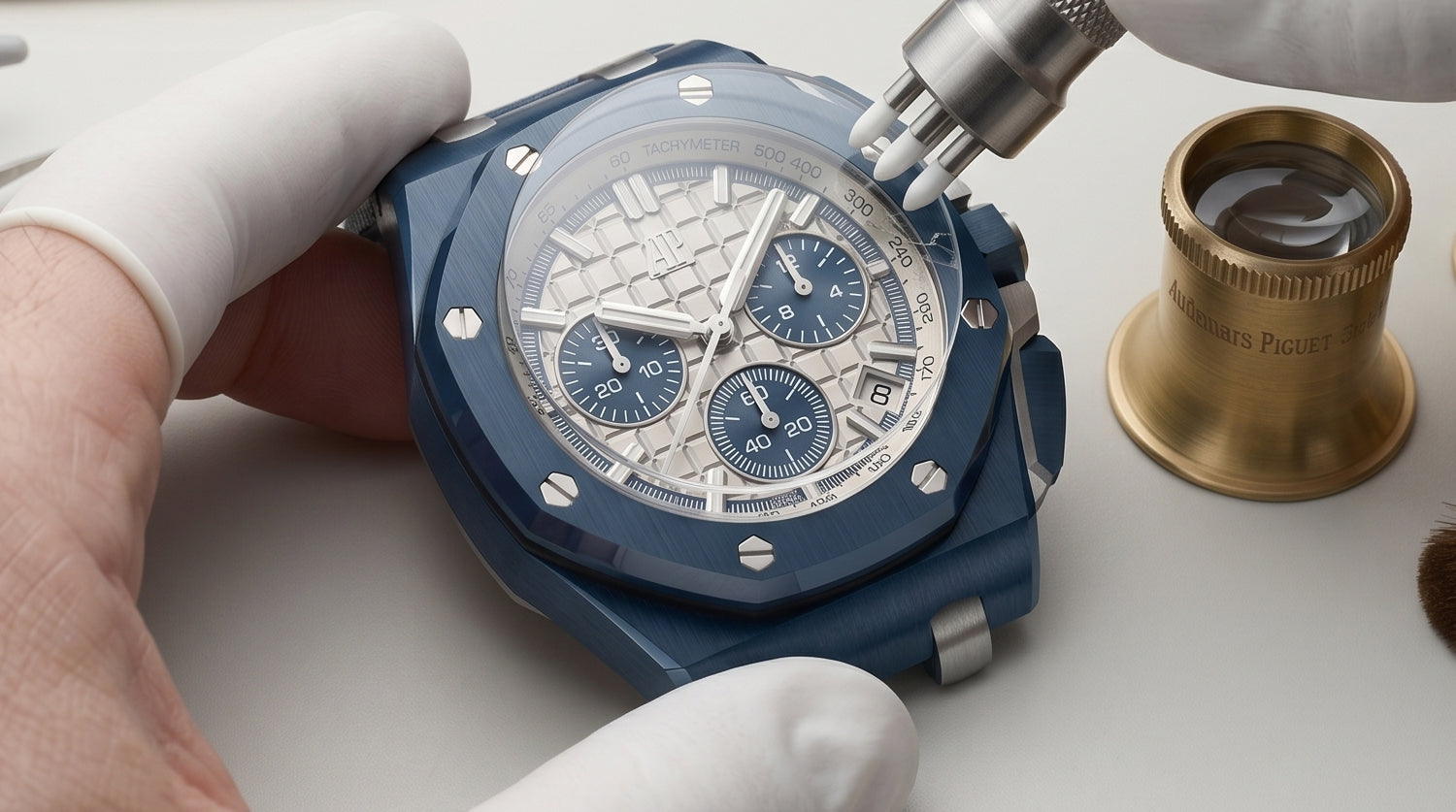
It was. The Offshore took the Royal Oak’s DNA and amplified everything. The case grew to 42mm and eventually 44mm. The bezel became thicker. The crown guards became more prominent. Rubber accents appeared on the case and strap. The overall effect was a watch that looked like it had been engineered for impact resistance rather than boardroom elegance.
The current Offshore lineup includes the chronograph (ref. 26420ST at 43mm), the Diver (ref. 15720ST at 42mm, rated to 300 metres), and various precious metal and complication variants. Cases range from 12.4mm to over 15mm thick depending on the model. These are substantial watches. You feel them on the wrist in a way that the standard Royal Oak deliberately avoids. What surprised me about the Offshore, and I’ll admit this took a while to appreciate, is that it has its own kind of refinement. The rubber-clad crown guards, the oversized pushers, the way the case integrates with the strap: none of it is arbitrary.
It’s a different design philosophy, but it’s executed with the same obsessive attention to detail that defines everything AP does.
The Real Differences
Size and presence. The standard Royal Oak at 41mm wears beautifully on most wrists. It sits flat, it disappears under a cuff, and it feels proportional. The Offshore at 42 to 44mm is a different proposition entirely. It’s thicker, heavier, and unapologetically present. If you have a smaller wrist (under 7 inches), the Offshore can overwhelm. Try both on before deciding.
Thickness.
This is the one that catches people off guard. The Royal Oak 15510ST is 10.4mm thick. The Offshore Chronograph 26420ST is around 14.5mm. That’s a huge difference in how the watch sits on your wrist and whether it slips under a shirt cuff. The Royal Oak slides under effortlessly. The Offshore does not, and it doesn’t pretend to.
Water resistance.
The standard Royal Oak is rated to 50 meters (splash-proof, essentially). The Offshore Diver is rated to 300 meters. If you actually intend to swim or dive with your watch, that distinction matters. If you don’t, it’s largely academic, but it does speak to the different design intentions behind each watch.
Movement and complications. Both lines use AP’s in-house calibers, finished to the same standard. The Royal Oak chronograph uses the caliber 4401 (flyback chronograph, column wheel). The Offshore chronograph uses the same movement. In terms of mechanical quality, they’re identical. The difference is entirely in the case, dial, and overall character.
Secondary market.
Royal Oak references in steel tend to hold their value exceptionally well, particularly the blue-dial 15510ST. The Offshore market is a bit more varied. Standard steel Offshore chronographs hold steady, but the more extreme limited editions can swing more dramatically. If resale value is a primary concern, the standard Royal Oak is the safer bet.

So, Which One?
If you want a watch that transitions seamlessly across every context in your life, a watch that’s as comfortable at dinner as it is on a Saturday morning, the Royal Oak is the answer. It’s one of the most versatile luxury watches ever made, and that versatility is its greatest strength. If you want something with more physical presence, something that leans into sport and aggression, something that announces itself rather than waiting to be noticed, the Offshore is built for you. It’s not trying to be the Royal Oak. It’s trying to be something the Royal Oak deliberately isn’t.
I’ve gone back and forth on this one more times than I’d like to admit. But if someone put a gun to my head? Royal Oak. Every time. The finishing at that thickness, in that case, with that bracelet, is something I haven’t found anywhere else. The Offshore is impressive. The Royal Oak is perfect.
We carry both Royal Oak and Royal Oak Offshore references. Browse the AP collection or request a specific reference.